
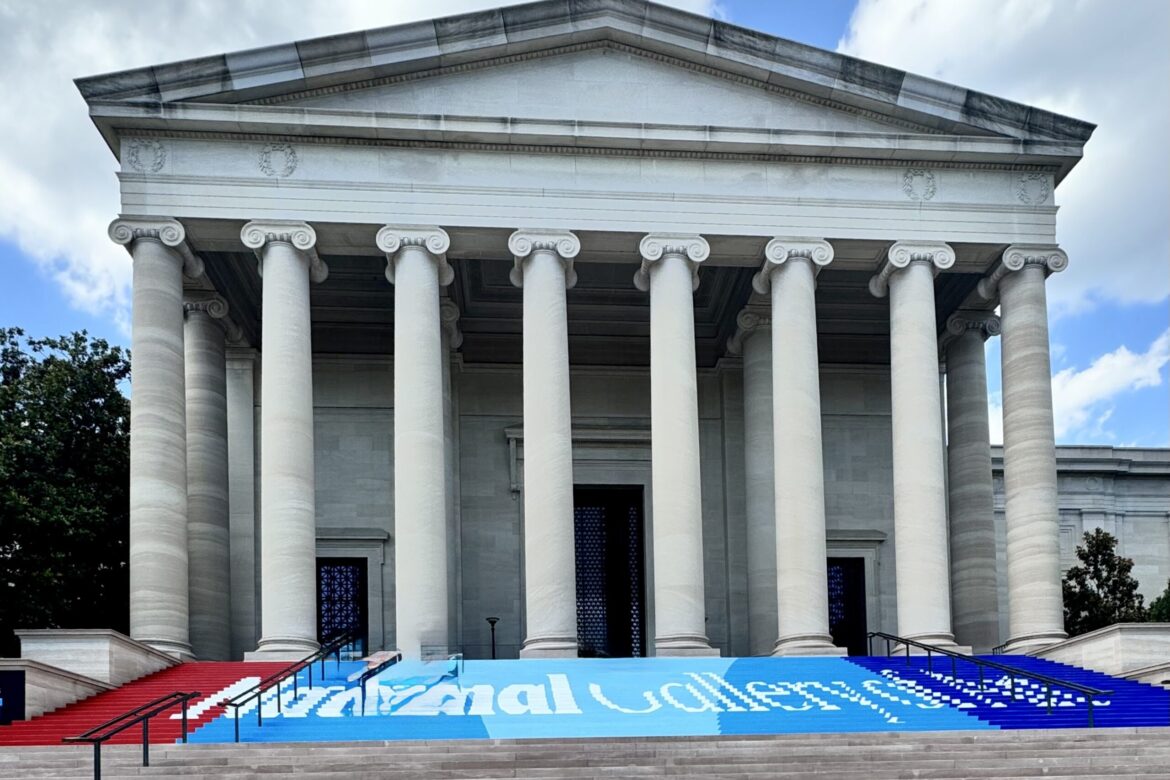
What Makes American Art Feel So American? Reflections on the National Gallery’s America’s 250th Exhibition
As someone who spends much of her time exploring museums in Paris, Florence, Rome, and beyond, I wasn’t expecting one of my favorite art experiences this year to take place in Washington, D.C. Yet during a recent visit to the National Gallery of Art’s America’s 250th: American Artists exhibition, I found myself thinking about a question that followed me from gallery to gallery: What exactly makes American art feel American?
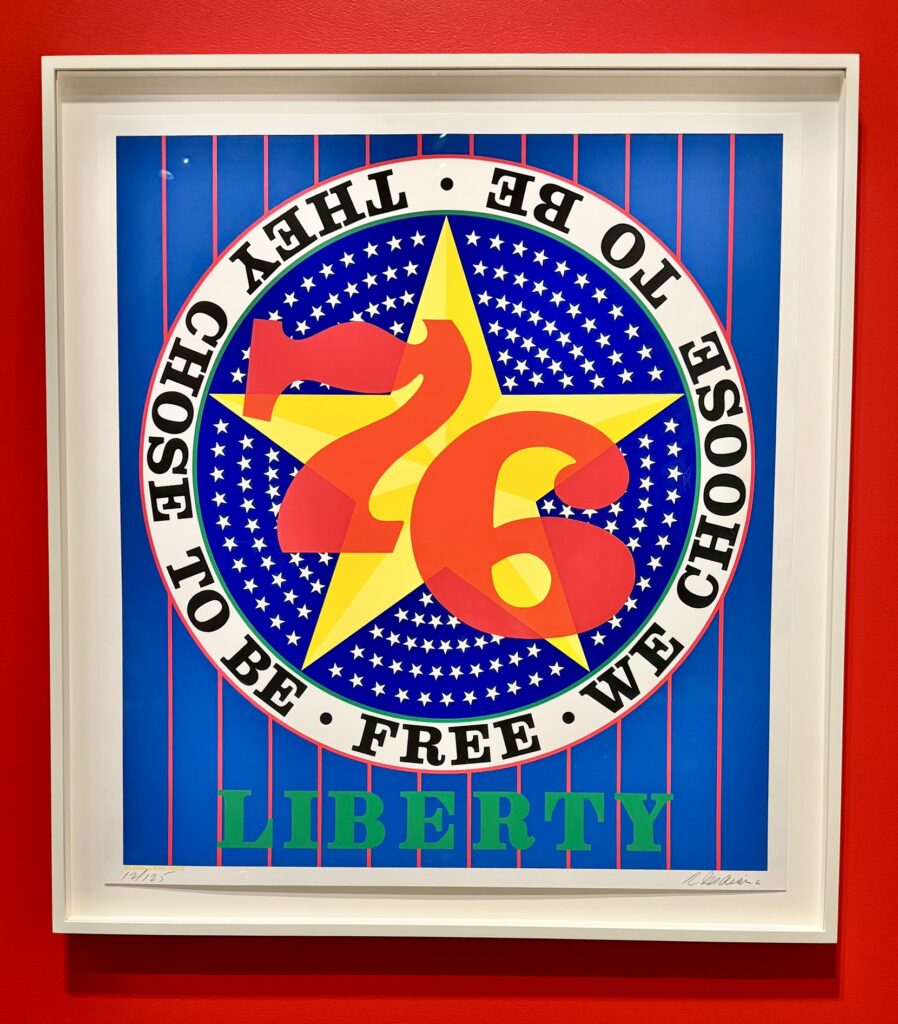
I spend a great deal of time looking at European art. I teach it. I travel to see it. I stand in front of Gothic cathedrals, Renaissance frescoes, Impressionist masterpieces, and centuries of artistic traditions that build upon one another. Walking through this exhibition felt different. The art wasn’t simply made in America—it felt distinctly American.
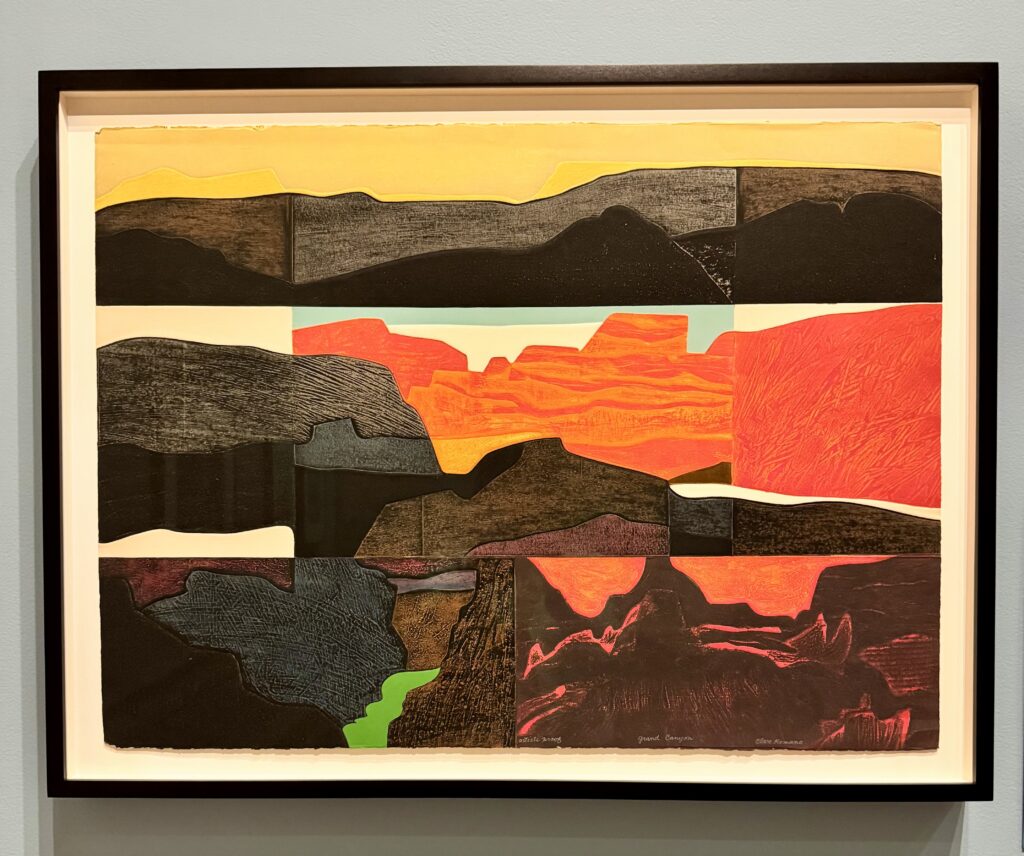
The exhibit specifically seeks to explore the questions “What does it mean to be American?” and “How have artists examined this question? Through more than 100 works on paper show how artists have explored the American experience over the last 250 years through depictions of the country’s landscape, people, and concepts of freedom. Wide-ranging works include photographs by Carleton Watkins and Carrie Mae Weems; prints by Thomas Hart Benton, Roy Lichtenstein, and Rupert García; and drawings by Thomas Moran, John Wilson, and Tonita Peña.
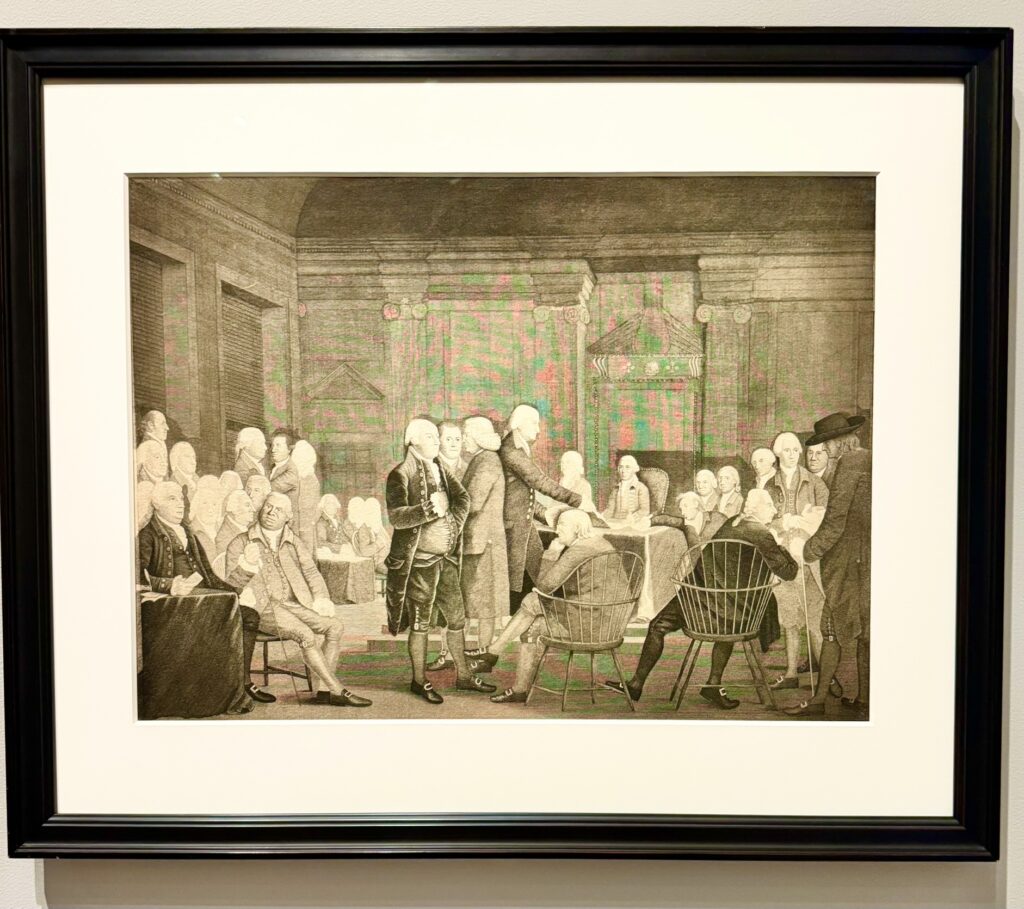
I marveled at the early American works, like this engraving by Edward Savage, depicting one of the most foundational and iconic moments in American History. Notice the date of the work is 1803. Meanwhile, in France, Jacques-Louis David was painting “The Coronation of Napoleon”, a work of art so phenomenal, so overwhelming, with such miraculous details, down to the seemingly 3-dimensional softness of the ermine fur of Napoleon’s royal robe. As a new country, even America’s art was almost childlike. As the exhibit aims to demonstrate, America would spend the next 250 years growing in her artistic capabilities.
A Nation Looking for Itself
Perhaps that is because American art is, in many ways, the story of a nation trying to define itself. European artists often worked within traditions that stretched back hundreds or even thousands of years. American artists inherited some of those traditions, but they also faced a different challenge: how do you create an artistic identity for a relatively young nation? The answer, as this exhibition demonstrates, was not one style but many.
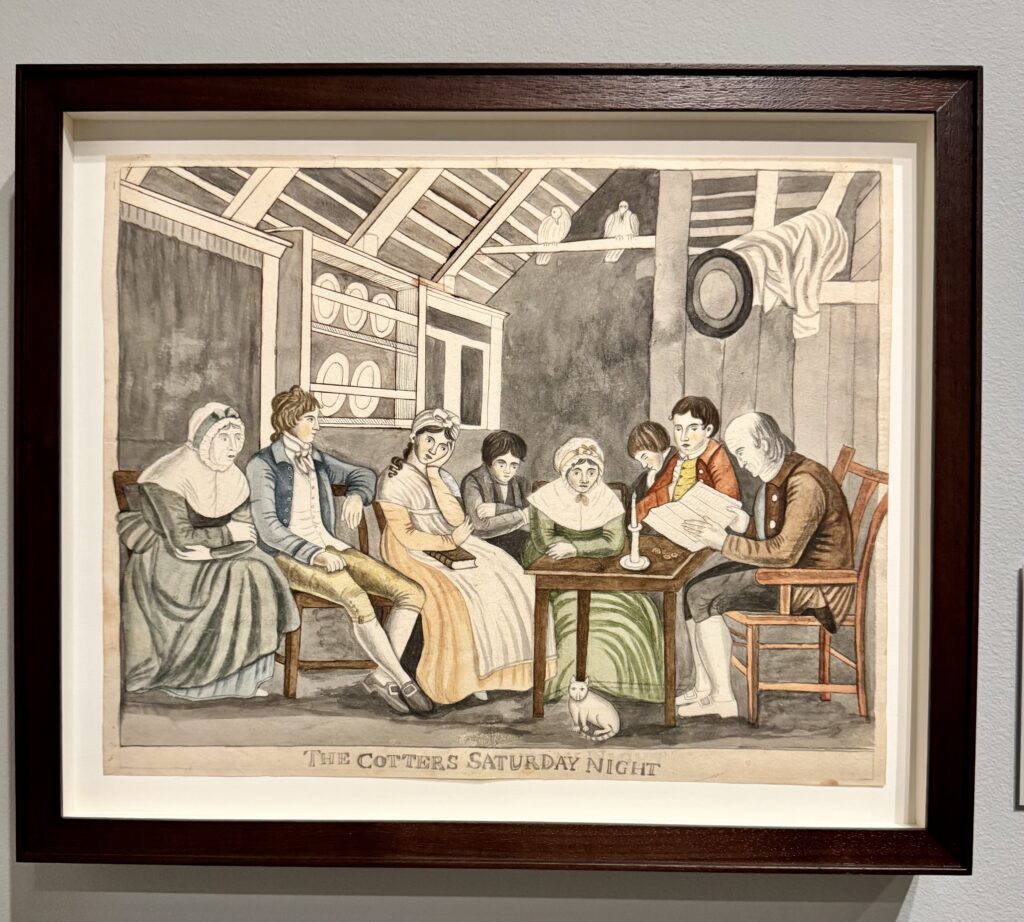
The exhibition brings together artists from different centuries, backgrounds, and artistic movements, yet they share a common thread: a fascination with American identity, landscape, history, and possibility.
The America of Paul Revere
One of the surprises of the exhibition was discovering that Paul Revere was more than the famous midnight rider from American history textbooks. His engraving of the Boston Massacre reminds visitors that artists have long shaped the way historical events are remembered. Long before photography, artists created the images that helped define public opinion and national memory.
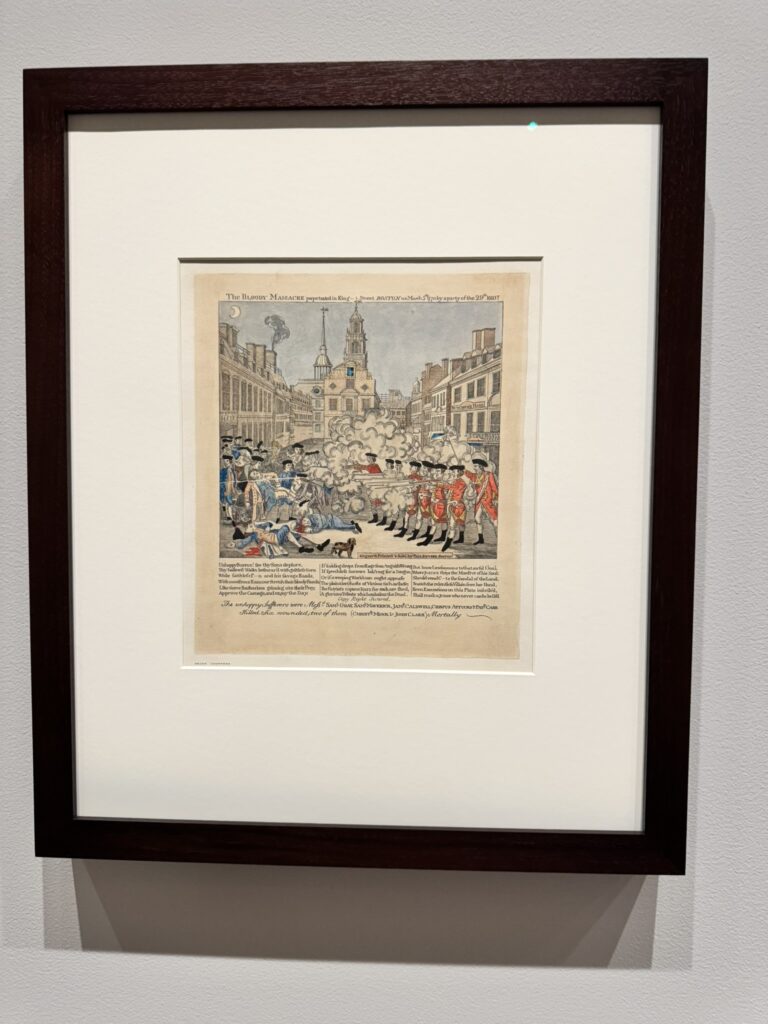
The Landscape as National Identity
The American landscape appears throughout the exhibition and perhaps nowhere more dramatically than in the works of Thomas Moran and Ansel Adams. Moran’s sweeping Western vistas capture the grandeur and scale of a country that seemed almost limitless. Adams’ photographs similarly transform mountains, valleys, and wilderness into something almost sacred. Often, these works generate that sense of sublime and almost terror at the enormity – just like the Romantic artists sought to achieve in the early 19th century.
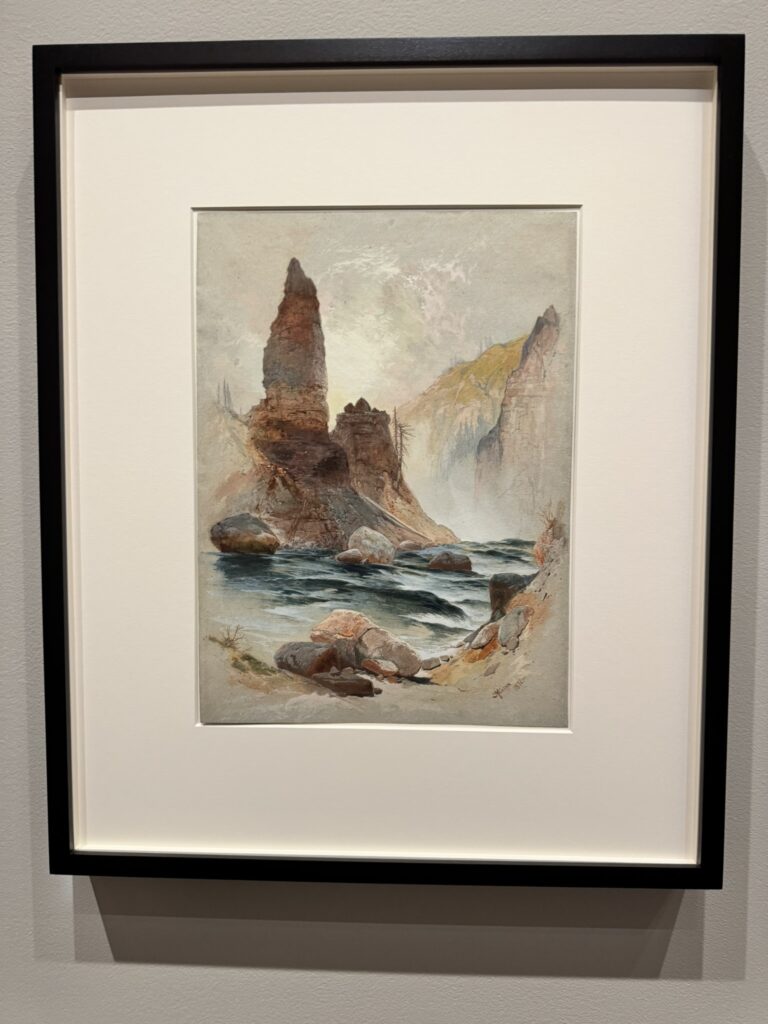
European landscape painting often celebrates cultivated countryside, ancient villages, or pastoral scenes shaped by centuries of human habitation. American landscapes frequently feel larger, wilder, and more untamed. They reflect a nation still discovering itself through its geography.
Reinvention and Experimentation
As the exhibition moves into the twentieth century, the artwork becomes increasingly bold and experimental.
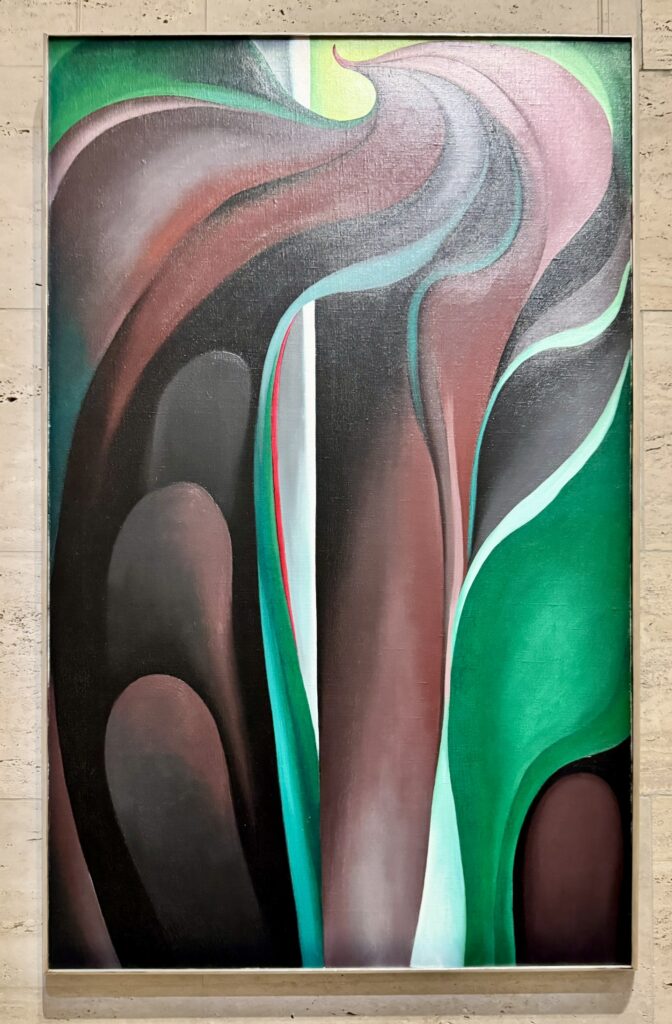
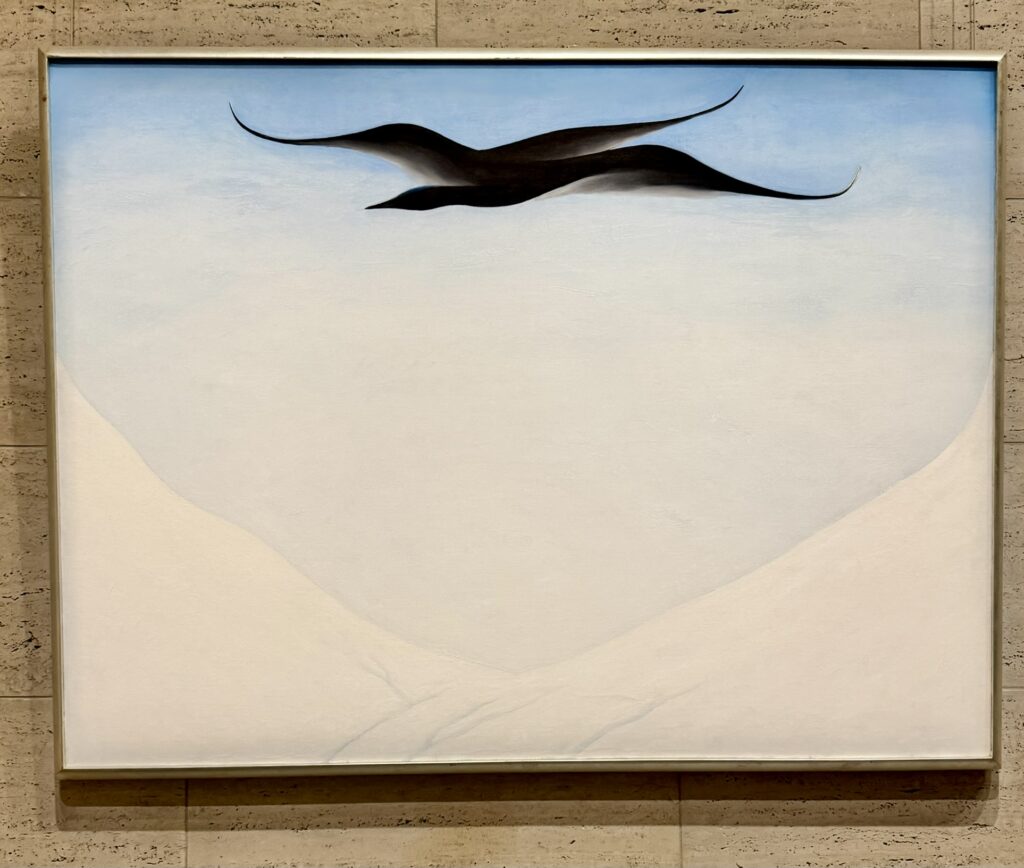
Georgia O’Keeffe’s iconic forms reduce flowers and landscapes to essential shapes and colors.
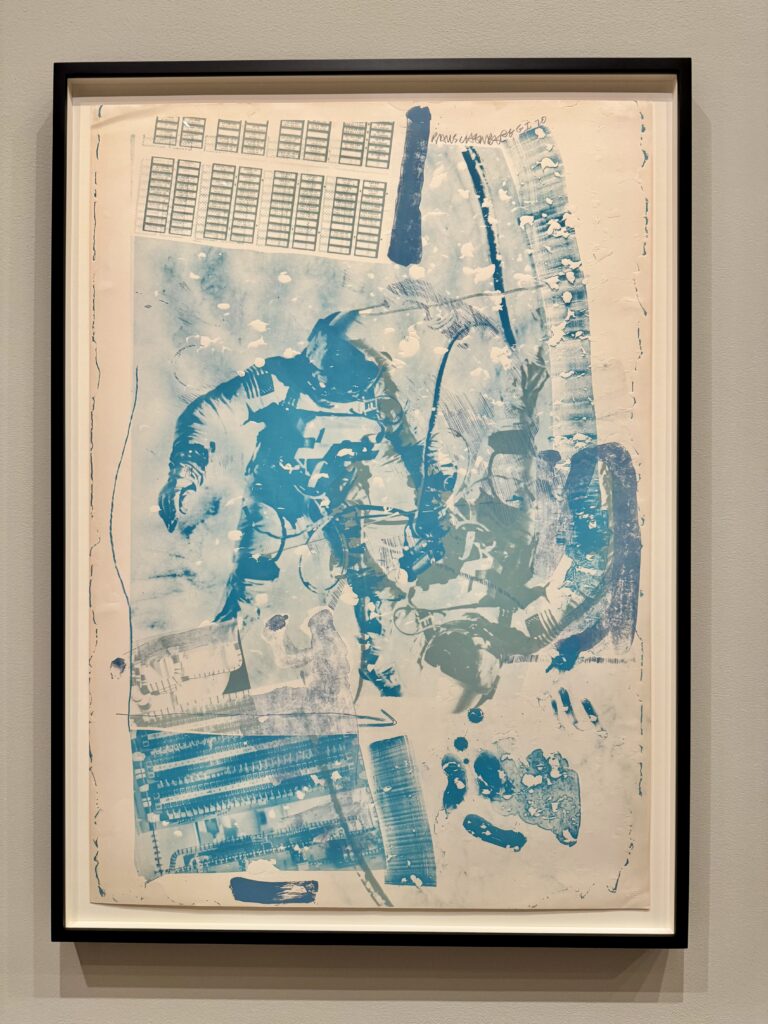
Robert Rauschenberg was not afraid to display awe and wonder after witnessing the launch of Apollo 11, the first spaceflight to land humans on the moon. He created a series of lithographs with layered images of photographs and charts from NASA along with hand-drawn subjects. Space exploration was the new frontier at that time. NASA commissioned artists like Rauschenberg to explore the subject in an effort to share information about the space program.
Ed Ruscha elevates language and everyday imagery into something unexpectedly profound. Gas stations, car culture and Route 66 became uniquely American in the mid-20th century. He highlights the effect of an ordinary gas station by depicting it as an idealized brightly colored, streamlined, modernist building. The horizontal bands of blue and orange in the back emphasize the distinctly vast sky of the American West.
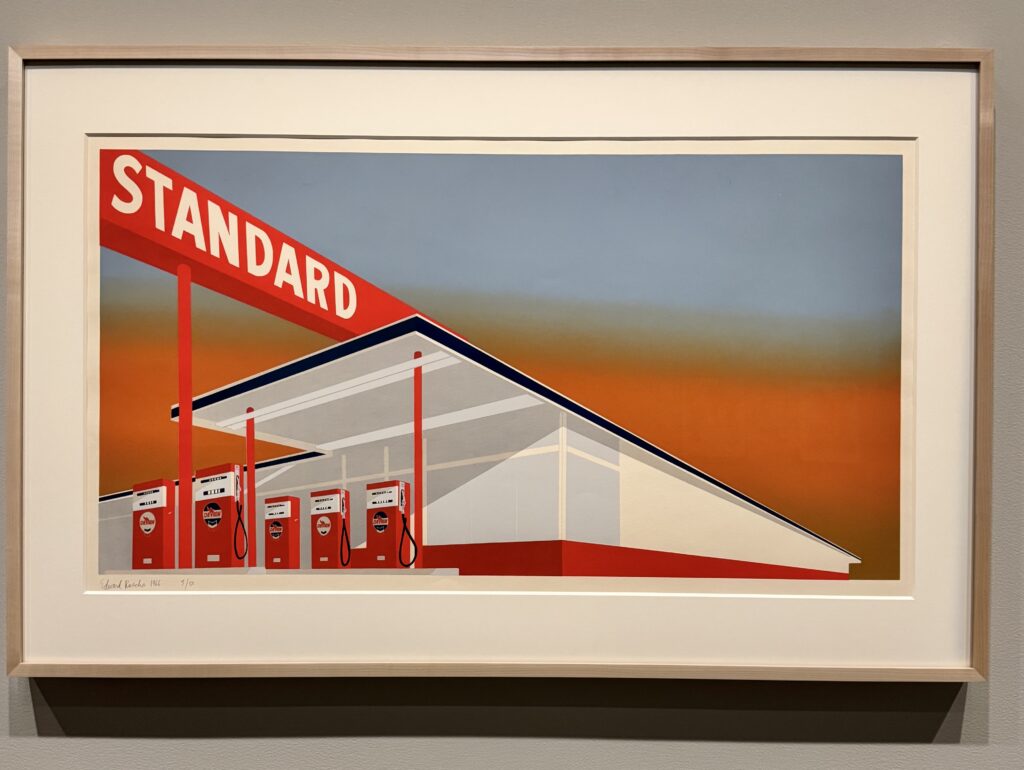
What struck me was the willingness of American artists to constantly reinvent themselves. There is a sense of artistic freedom throughout the galleries—a willingness to question, challenge, and experiment. Rather than looking backward toward tradition, many American artists seem focused on creating something entirely new.
Multiple Voices, One Story
The exhibition also highlights artists whose work expands our understanding of the American experience.
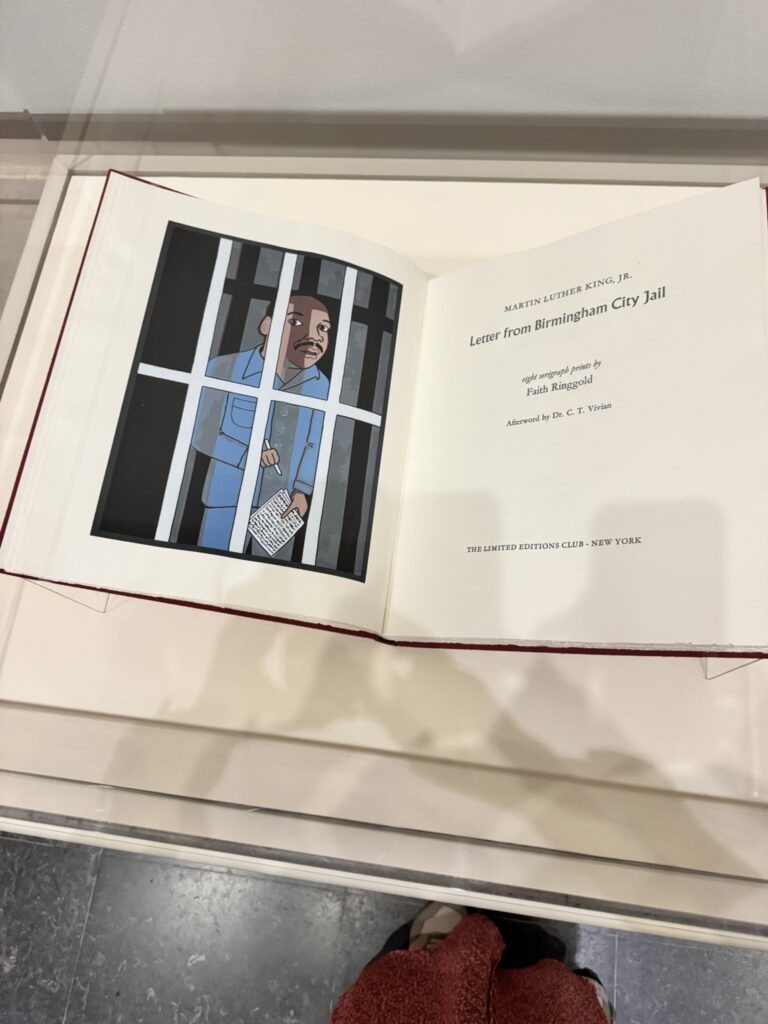
Faith Ringgold’s storytelling quilts combine art, history, and social commentary. She created 8 screenprints of events from the civil rights movement to accompany the test of Dr. Martin Luther King Jr.’s, “Letter from Birmingham City Jail” which he wrote in1963.
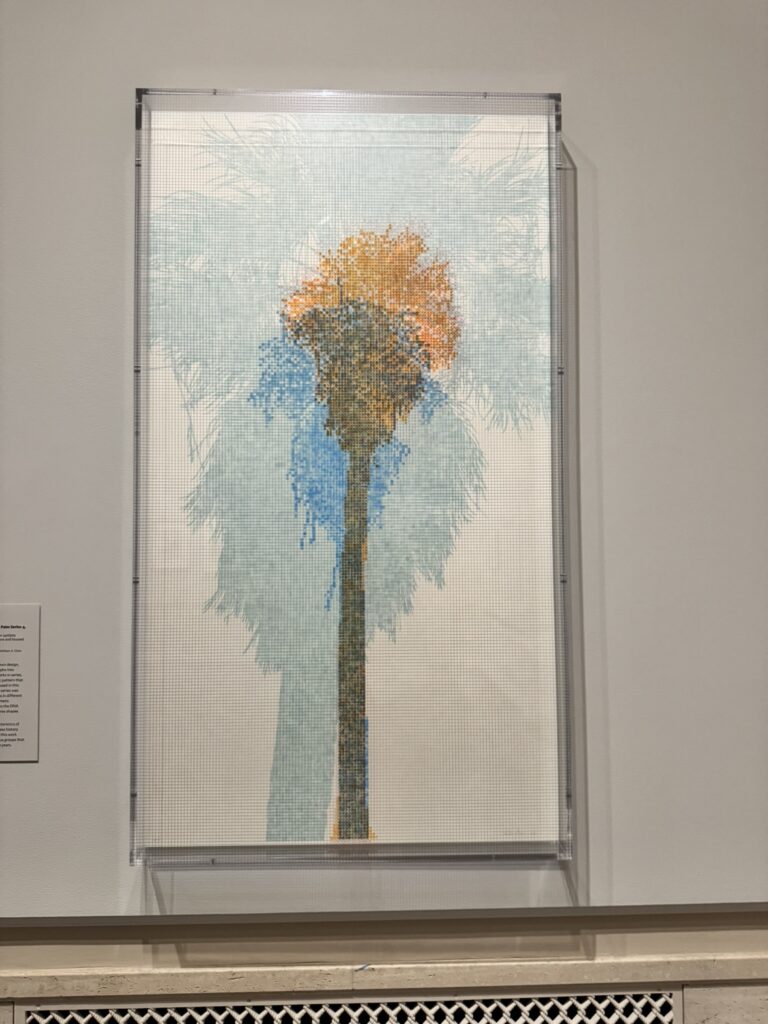
Charles Gaines used mathematical systems of his own design to change photographs into conceptual works of art. Gaines’ numeric configurations of their forms are a nod to the DNA of the plants and the overlapping tree shapes hint at time passing. Trees reflect the characteristics of the land where they grow – the palm tree is synonymous with Southern California. Gaines titled this work Kitanemuk after an indigenous tribe that had inhabited Southern California for 13,000 years.
John Wilson’s larger than life series entitled “Young Americans” created in the mid-1970’s was his vision of the young American generation and their potential.
Together, these artists remind visitors that there is no single American story. Instead, America emerges as a collection of voices, experiences, perspectives, and histories that continue to shape the nation today.
What I Took Away
As I left the exhibition, I realized that what felt so distinctly American was not a particular artistic style but was rather the spirit of the work itself. American art often feels restless, curious, inventive. Sometimes it feels naive and optimistic. Sometimes it is highly critical.
Unlike many European museums, where visitors can trace artistic traditions across centuries, this exhibition felt more like an ongoing conversation about identity—about who Americans are, who they have been, and who they hope to become. And for someone who spends most of her time immersed in European art, that perspective felt refreshingly—and unmistakably—American.
What to Know about Visiting the National Gallery in Washington D.C.
Tickets & Passes: Tickets are not required for general admission! Walk right in, though you can check the National Gallery of Art Calendar for any ticketed special exhibitions.
Connecting the Buildings: The West and East buildings are connected by an underground concourse featuring a famous moving light tunnel and a cafe.
Dining & Amenities: There are five different dining options on campus, including the elegant Garden Café and a few grab-and-go espresso bars.
Tours: If you want a structured experience, take advantage of the free daily docent-led tours and themed gallery talks.
How to Tackle the Museum
If you have 2 hours: Focus on the West Building highlights, take the light tunnel to the East Building, and do a quick loop of the modern art.
If you have 4+ hours: Explore both buildings thoroughly, grab lunch at the Garden Café, and enjoy the Sculpture Garden.
Accessibility: Both buildings are completely wheelchair accessible, and strollers are welcome for families.
Need a Place to Stay in Washington DC?
Search the map here:
Need a Ride?
Where to See More Great Art in the USA:
Exploring the Kimbell Art Museum: A Masterpiece of Art and Architecture
Artist Lindsay Goodwin Captures the Magic of Paris and France
A Beautiful Day at the Utah Museum of Fine Arts
A Tour of Shangri La, Doris Duke’s Historic Home on Oahu
Palm Springs Art Museum: Impressionism to Abstract Expressionism
Inspired by France: Artists at the Norton Simon Museum influenced by Paris
Caspar David Friedrich: “The Soul of Nature” at the Met – A Journey into Romantic Sublime
If You Enjoyed this Post, You Might Also Enjoy:
- What Makes American Art Feel So American? Reflections on the National Gallery’s America’s 250th Exhibition
- La Caverne du Pont Neuf: JR’s Monumental Transformation of Paris’ Most Famous Bridge
- Where I Ate in Paris in the Spring: A 4-Day Paris Restaurant Guide
- The Most Beautiful Spring 2026 Cookbooks (with French & Italian Soul)
- Insider’s Guide to Mediterranean Cruising
Be sure to follow my Instagram to see where I have been and where I am going.
Need Art-Viewing Style Inspiration?
Head to my LTK shop for fashion and home.
You can shop my Amazon shop with a selection of Art and Architecture books:











Leave a Reply